
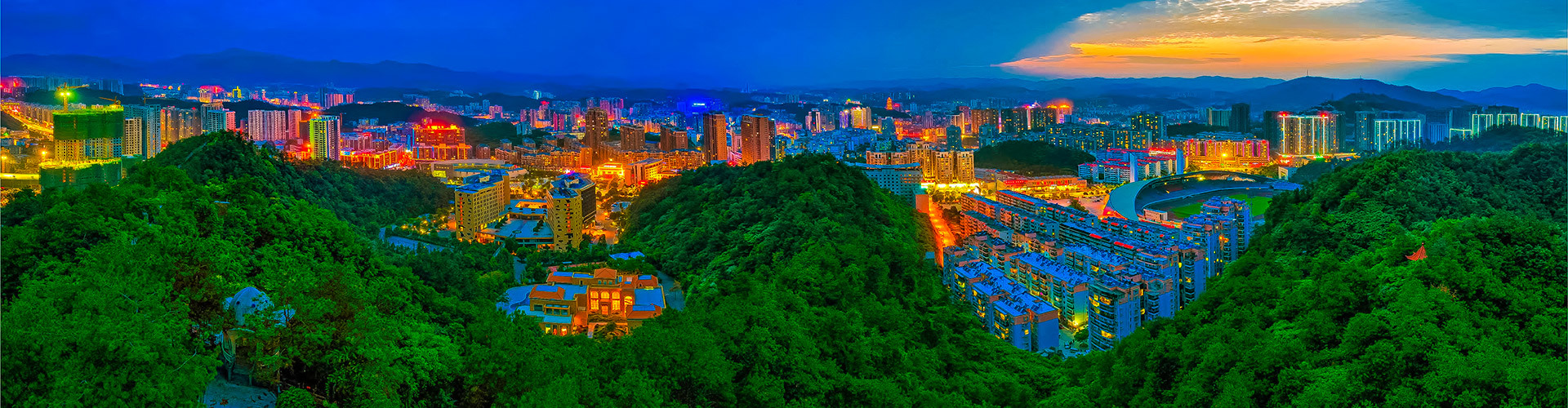
Brief introduction of all districts and counties

Wudang Mountain Tourism Special Economic Zone
Wudang Mountain Tourism Special Economic Zone is located in Shiyan City, Hubei Province, China with the ancient city of Xiangfan in the east, the virgin forest of Shennongjia in the south, Shiyan City in the west, and the largest artificial lake in Asia - Danjiangkou Reservoir in the north.
Bailang Economic Development Zone
The Bailang Economic and Technological Development Zone is connected to Wudang Mountain in the east, prosperous urban area in the west, Han River in the north, and Sai Wudang in the south. The terrain is flat and open. The area of the Bailang Economic and Technological Development Zone is about 93 square kilometers, with a population of 60000. Postcode: 442000. In the Bailang Development Zone, Xiangyang Chongqing Railway runs from east to west and reaches the whole country; G70 Fuzhou Yinchuan Expressway passes through the area; The adjacent Wudang Mountain Airport can fly to many large and medium-sized cities in China; Dengwan and Meadow Wharf can directly reach the eastern coast. Located at the source of the automobile industry in Hubei Province, the development zone is the east gate of Shiyan City.
Maojian District is a county-level district under the jurisdiction of Shiyan City, Hubei Province, located in the middle of Shiyan. The district is adjacent to Shiyan Economic Development Zone and Liuliping Township of Danjiangkou City in the east. In the west, its boundary is roughly along the northeast-southwest line of Sifang Mountain in the central area of Shiyian - Bijia Mountain - Niutou Mountain, and is connected with Zhangwan District. It extends to Dachuan Township and is adjacent to Fangxian County in the north. As for the north, Maojian District stretches to Wuyan Street and is neighbor to Hanjiang Road in Zhangwan District.
Zhangwan District is under the jurisdiction of Shiyan City, Hubei Province. It is located along the Duhe River and the Hanshui River. It is the core water source area of the Middle Route of the National South-to-North Water Diversion Project, the birthplace of China’s second automobile work, and home to the headquarter of Dongfeng Commercial Vehicle. The district is known as China’s “truck capital,” and ranks the largest economy in Shiyan City. It has jurisdiction over 2 villages, 2 townships, 4 sub-districts, 1 provincial economic development zone and 1 industrial new district. It covers an area of 657 square kilometers and has a total population of 433,000. Many railways and highways, including Wuhan-Shiyan High-speed Railway, Hubei-Chongqing Railway, National Highway 316, National Highway 209, and Yinchuan-Wuhan Highway. The tourist attractions include Dongfeng Automobile Industry Tourism Zone, Sifang Mountain Ecological Park, and Huanglongtan Industrial Ecological Tourism Zone.
Yunyang District covers an area of 3863 square kilometers, governs 19 townships (farms), 1 economic development zone, 348 village (residents) committees, and has a total population of 630000. In ancient times, it was called "Yanjiang". Xia was an ancient village. In Han Dynasty, Xi County was set up, in Jin Province, Yun Township was set up, and in Yuan Dynasty, Yun County was changed. In the 12th year of Chenghua's reign in the Ming Dynasty (1476 AD), Yunyang Prefecture was set up in Yun County, and the imperial court sent additional governors to govern 65 counties in Jiuzhou. After the founding of the People's Republic of China, a county was set up first and then an administrative office was set up. In 1967, the administrative office was moved to Shiyan and became a county of an independent administrative region. On September 9, 2014, the State Council approved the removal of Yunxian County and the overall change to Yunyang District.
Danjiangkou City is located in the northwest of Hubei Province, the middle and upper reaches of the Han River, the junction of Jianghan Plain and Qinling Bashan Mountains, and the junction of Hubei and Henan provinces. With a total area of 3121 square kilometers, the city has jurisdiction over 20 towns (offices, divisions, districts), 194 villages, and a total population of 470000. It is the core water source area of the Middle Route Project of the South to North Water Transfer, a national civilized city, a national health city, a national garden city, "the fourth batch of 'green water and green mountains are Jinshan and Yinshan' practice and innovation bases", and one of the top 100 happy counties (cities) in China. From 2013 to 2019, it was awarded the title of "Outstanding Unit in County Economy Work of the Province" for seven consecutive years, and was selected into 21 key counties (cities) of high-quality development in Hubei Province.
Yunxi is located in the northwest of Hubei Province, adjacent to the Qinling Mountains in the north and the Han River in the south. It is adjacent to Shangnan, Shanyang, Zhen'an, Xunyang and Baihe counties of Shaanxi Province and Yunyang District of the province. Fuzhou Yinchuan Expressway passes through the area. The 209 National Highway runs through the north and south. The Wuxi High speed Railway is about to set up a station. It is an important post station of the "Qiaotou Fort", the ancient water transport and the ancient tea and horse road, and an important channel of the ancient Silk Road from central China and northwest to the east. The county covers an area of 3509 square kilometers, has jurisdiction over 18 townships (towns and districts), 286 village (neighborhood) committees, and a total population of 510000. Yunxi is a national key county for poverty alleviation and development in the new stage, a national health county and a national garden county, as well as the upstream core area of water source protection for the Middle Route Project of South to North Water Transfer.
Zhushan County is located in the mountainous area of northwest Hubei. It borders Fangxian County in the east, Zhuxi County in the west, Yunxian County in the northeast, Shaanxi Province in the north and Shennongjia Forest Region and Sichuan Province in the south. The whole county is narrow in the south and wide in the north, and narrow in the south and long in the south. The total area is 3581 square kilometers, the cultivated land area is 36400 hectares, and the total population is 461600. Zhushan County is located in the eastern part of Daba Mountain in the margin of the Qinling Mountains. It is mainly mountainous and complex. Water resources are abundant. There are dozens of tributaries and streams flowing into the Hanjiang River. The whole county is basically "eight mountains, one water and one farmland". Due to the mountainous terrain, Zhushan County is rich in mineral resources, including stone coal, pyrite, copper, uranium, gold, silver, antimony, manganese, asbestos, turquoise, barite and rare earth. Bamboo Mountain is located in the high mountain area, with many kinds of animals and plants. The wild animals mainly include Yunba cattle (formerly called Miaoya cattle), horse headed sheep, Zhushan chicken (commonly known as Daji), etc., which are excellent varieties in the province. The medicinal materials mainly include Chinese gall, with the highest annual output of 800000 kg, ranking first in the country.
Copyrights © 2022 SCTSID All Rights Resrved
This website has supported IPV4/IPV6 two-way access